If you’ve ever struggled with manually adjusting a heavy wooden pergola’s slats, or wished for a way to tune outdoor shade and ventilation without wrestling with awkward hardware, you’ve probably wondered about the magic behind a hand-crank aluminum pergola. As a supplier who’s built and supported hundreds of these systems for residential and commercial clients over the last 12 years, I get this question all the time: How does the hand-crank system actually work? It’s not just a fancy add-on—it’s a precision-engineered mechanism that balances durability, ease of use, and performance, all tailored to aluminum’s unique properties as a pergola material. Let’s break it down, step by step, no confusing jargon, just the honest, practical explanation I give to every contractor and homeowner who stops by our showroom. Hand-Crank Aluminum Pergola

First, let’s start with why aluminum is the perfect base for this system. Unlike wood, which warps, rots, or sags after years of sun and rain, aluminum is lightweight but rigid—enough to support the weight of adjustable slats without bending, but not so heavy that a manual crank feels like a workout. That balance is non-negotiable. If a pergola frame was too flimsy, the crank would pull it out of alignment; if it was too heavy, even a strong adult couldn’t turn the gear. For our systems, we use 6061-T6 aluminum, the same grade used in boat masts and aerospace components, because it’s corrosion-resistant (no rust spots on your patio after a rainstorm) and has a tensile strength strong enough to hold slats steady in 25 mph wind. That foundation is what lets the hand-crank system do its job reliably, year after year.
Now, the hand-crank mechanism itself is tucked away in a small, weatherproof housing at one end of the pergola’s header beam—you’ll never see it unless you’re looking for it. The core of the system is a worm gear drive, and that’s where most of the magic happens. Let’s put it simply: a worm gear is like a screw, and it meshes with a smaller gear (called a pinion) attached to the main shaft that runs the length of the pergola. When you turn the crank handle, the worm (the screw) spins slowly, and as it turns, it moves the pinion gear. This setup has a huge mechanical advantage—like using a crowbar to lift a heavy rock. For every full turn of your crank, the pinion gear only moves a tiny fraction, which means you’re not fighting the weight of the slats or the tension in the cables. A lot of people ask if electric versions are better, but for 90% of our customers, the hand crank is a game-changer: no wiring, no batteries, no risk of a dead motor when you need to adjust shade at 7 a.m. for a breakfast party.
Next, that spinning shaft from the worm gear connects to a set of drive cables and tensioners that run along the top of the pergola frame, attached to each adjustable slat. Here’s where we’ve refined the design over the years to avoid common problems. Early versions had loose cables that would sag after a few adjustments, leading to misaligned slats. Now, we use aircraft-grade steel cables coated with vinyl to resist UV damage, paired with spring-loaded tensioners at either end of the shaft. Those tensioners act like a shock absorber: if a slat gets a little stuck, or a gust of wind tugs on the frame, the spring gives just enough to keep the cable tight, so your crank never slips or jumps. Each slat is also connected to the main shaft via a small, high-density nylon pivot—nylon is quiet, doesn’t rust, and can handle thousands of adjustments without wearing out. We test every system for 1,000+ cranking cycles in our warehouse, and after that, most of our customers still haven’t had to do any maintenance beyond a quick wipe-down once a year.
Let’s walk through a real example of how this works in action. Imagine it’s a Saturday in June, and you want to open your pergola slats to let midday sun hit your patio, then close them by 3 p.m. as the temperature cools. You grab the crank handle (it’s aluminum too, so it won’t get too hot or too cold to touch) and give it a full turn clockwise. That spins the worm gear, which moves the pinion, which turns the main shaft. The shaft pulls the cables, which lift the back edge of each slat just a tiny bit—enough to angle the slats open to 15 degrees, letting filtered sun through. Give it another 10 turns, and the slats angle all the way to 90 degrees, fully open for maximum sunlight. If you want to close them, just turn the crank counterclockwise: the worm gear reverses direction, the shaft pulls the opposite end of the cables, and each slat pivots down to fully cover your patio, blocking 95% of direct rain and UV.
Wait, you might be wondering: why a worm gear, specifically, instead of a regular gear? That’s a critical detail. Worm gears are self-locking—meaning they can’t be turned backward by the weight of the slats or wind. If you’ve ever had a manual awning roll back down on its own, you’ll know how annoying that is. With a worm gear system, once you stop turning the crank, the slats stay exactly where you left them, even in a light breeze. We’ve had customers tell us their pergola slats haven’t moved an inch in a year of light use, and that’s exactly the reliability we build into every system.
Another common question: can the hand-crank system work on larger pergolas, like 20-foot wide commercial units? Absolutely. We’ve installed systems on pergolas up to 30 feet wide, and we size the worm gear and cables to match. For larger units, we add a secondary support bracket in the middle of the main shaft, so the weight of the slats is evenly distributed. We also use a crank handle with a longer grip for commercial clients who might be adjusting the pergola multiple times a day—no hand strain, even when cranking to fully open 12 slats. For residential units, we include a standard handle that fits easily in a tool drawer or by the patio door.
Now, let’s talk about what makes our hand-crank pergola different from the competition. A lot of suppliers cut corners on the internal parts to lower costs, using plastic gears instead of nylon, or standard steel cables instead of coated ones. Those systems break within a few years, especially in coastal areas where salt air eats through uncoated metal. We test all our components in a salt spray chamber for 500 hours (equivalent to 10 years of coastal exposure) to make sure nothing rusts or wears out. We also design the crank housing to be flush with the pergola frame, so it doesn’t catch on wind-blown leaves or furniture, and it’s sized to fit a standard wall outlet if a customer ever wants to upgrade to a motor later—no need to rework the frame, just swap out the crank for a motor attachment.
I get it, if you’ve never owned an adjustable pergola, this might sound complicated, but in practice, it’s dead simple. You don’t need tools to adjust the slats, you don’t have to worry about programming a remote, and it’s way more reliable than a wooden pergola that sags and has to be sanded and stained every other year. Our customers love that it’s low-maintenance: once a year, just spray a little silicone on the crank handle to keep it turning smoothly, and wipe the housing clean with a damp cloth. No pressure washing, no special treatments, no headaches.
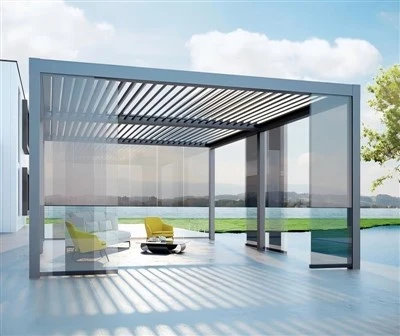
At the end of the day, a hand-crank aluminum pergola’s system is all about balance: between function and durability, ease of use and performance. It’s not a gimmick—it’s a solution that lets you control your outdoor space exactly how you want it, whether you’re hosting a summer cookout, relaxing with a book, or protecting your patio furniture from a sudden afternoon rainshower. If you’re ready to upgrade your outdoor space with a system that’s built to last, or if you’re a contractor looking for a reliable supplier for your next project, we’re here to help. We can share installation guides, talk through sizing for your space, and even connect you with local installers if you don’t want to handle the build yourself. When you choose our hand-crank aluminum pergolas, you’re not just getting a shade structure—you’re getting a system that works, year after year, without the hassle. Reach out today to discuss your specific needs and get a custom quote that fits your budget.
Aluminum Doors References
- Aluminum Association. (2022). 6061-T6 Aluminum: Properties and Outdoor Application Guidelines.
- American Institute of Steel Construction. (2021). Aircraft-Grade Cables for Outdoor Structural Systems.
- Pergola Design Institute. (2020). Mechanical Advantage in Manual Shade Structures.
- National Association of Home Builders. (2019). Low-Maintenance Outdoor Hardware Testing Standards.
Shandong RobynGoods Imp&Exp Co., Ltd.
As one of the most professional hand-crank aluminum pergola manufacturers and suppliers in China, we also support customized service. Please rest assured to wholesale discount hand-crank aluminum pergola in stock here from our factory. Quality products and reasonable price are available.
Address: Room 414, Shengdiguangyao Mansion, Shencheng Subdistrict, Shouguang, Weifang, Shandong Province, China
E-mail: info@robynoutdoor.com
WebSite: https://www.robynoutdoor.com/
