If you’ve walked through an automotive assembly plant, a furniture manufacturing facility, or even a large appliance factory lately, you’ve probably noticed a quiet shift happening: spray painting robots are no longer a novel add-on—they’re the backbone of consistent, high-quality finish work. As a spray painting robot supplier, I get asked this question at least once a week: “How repeatable is your equipment, really?” It’s a fair question, because anyone who’s ever watched a robot lay down a coat of paint that’s too thin in one area and too thick in another knows that repeatability isn’t just a buzzword—it’s the difference between scrap parts, wasted material, and a reputation for quality. Let’s break down what spray painting robot repeatability actually means, what factors impact it, and how you can measure it for your own operation. Spray Painting Robot
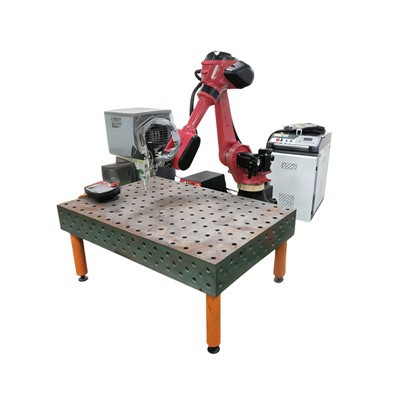
First, let’s clear up a common misconception: repeatability isn’t the same as accuracy. Accuracy is how close a robot’s actual path is to the exact programmed path. If you program a robot to spray a spot dead-center on a car door, accuracy is how often it hits that exact spot. Repeatability, though, is about consistency—how often the robot hits that same spot, over and over, even when small variables come into play. For spray painting, that distinction is make-or-break. A robot could have perfect accuracy, but if it drifts even a millimeter every cycle, you’ll get uneven coat thickness, runs, or missed spots. That’s where repeatability shines. It’s what ensures every part coming off the line has the same finish, no matter how many times you run the robot.
So, what’s the real-world number for spray painting robot repeatability? Industry-standard articulated arm spray painting robots (the most common type for automotive, aerospace, and consumer goods) typically offer a repeatability of ±0.05 millimeters to ±0.2 millimeters. At first glance, that might seem tiny—less than the width of a human hair. But here’s the context: a single coat of automotive base coat is usually between 20 and 40 micrometers thick (0.02 to 0.04 millimeters). So a 0.1 millimeter repeatability means the robot can hold its position enough to lay down a coat that’s consistent within a few percent of the desired thickness. Compare that to a human painter, who has a repeatability of roughly ±1 to 2 millimeters at best, and you can see why robots replaced hand spraying in high-volume operations.
But repeatability isn’t a one-size-fits-all number. It depends on two big sets of factors: the robot’s hardware design, and how you set it up and maintain it. Let’s start with hardware. The motors, gearboxes, and encoder systems that a robot uses to track its position are the foundation of its repeatability. For example, robots designed specifically for spray painting use precision harmonic drives and stepper motors with high-resolution encoders (up to 1 million counts per revolution, compared to 100,000 on lower-cost general-purpose robots) to eliminate slippage between the motor and the arm joints. A general-purpose industrial robot might work for moving parts, but it can’t match the fine control of a purpose-built spray painting robot. Even the structure of the arm matters: lightweight carbon fiber arms reduce inertia, so the robot can stop and start on a dime without flexing, which would throw off its path and reduce repeatability.
Then there’s the end-of-arm tooling (EOAT)—the spray gun, color change valves, and mounting brackets. A poorly designed EOAT is one of the biggest hidden threats to repeatability. If your spray gun isn’t aligned perfectly with the robot’s arm, or if the mounting bracket wobbles when the arm moves, every cycle will have a slightly different gun angle or position. For example, a 1-degree tilt in the spray gun can change the pattern of the paint by a few millimeters at the part, leading to uneven coverage. That’s why at our company, we work with clients to design custom EOAT that’s rigid, balanced, and aligned to within 0.02 millimeters of the robot’s tool center point (TCP)—the exact point where the spray leaves the gun. The TCP is the linchpin here; if you can’t consistently track where the gun is spraying from, you can’t have consistent repeatability.
Now, let’s talk about operational factors, because even the best robot won’t repeat perfectly if it’s not set up right. First is calibration. Every six months to a year, your spray painting robot needs to be recalibrated to account for minor wear in the joints, thermal expansion from the motor’s heat, and even changes in the factory’s floor temperature (which can cause the arm to expand or contract by a few tenths of a millimeter). Skipping calibration is a common mistake: one of our clients, a small furniture manufacturer, tried running their robot for 18 months without recalibration, and ended up with a 15% scrap rate on dining table parts because the robot’s position had drifted enough to cause uneven edge coverage. Regular calibration checks—we recommend doing a quick TCP verification before every shift, and a full calibration every 3 months for high-volume lines—keep repeatability on track.
Next is program consistency. Spray painting isn’t just about moving the robot from point A to point B; it’s about matching the gun speed, pressure, and fan pattern to the part’s shape. If a programmer rushes through the robot path, or doesn’t account for curved surfaces on a part, the robot will slow down for corners one cycle and go fast for them the next, leading to thicker coats on flat areas and thinner ones on edges. That’s why we offer program auditing services: our team will review your robot’s path to ensure every segment has consistent speed, and adjust for overspray and edge coverage. For example, when we worked with an aerospace client painting small turbine blades, we adjusted the robot’s path to slow down by 20% at the blade’s thin leading edges, which boosted their repeatability in coat thickness from 82% to 97%—a huge win for meeting aerospace’s strict finish standards.
Material compatibility also plays a role, which might surprise some people. Paint viscosity, solvent evaporation rate, and even the type of colorant can affect how the robot’s spray pattern behaves, and in turn, how consistent the finish is. If you’re using a high-solid paint that’s thicker than the robot was calibrated for, the spray pattern might be slightly narrower, so you’ll need to adjust the gun’s distance from the part. Many low-cost spray painting robots don’t have adjustable pressure feedback, so they can’t compensate for changes in paint properties, leading to variable repeatability. Our robots, though, come with integrated material sensors that adjust pressure and fan pattern in real time, so even if your paint batch changes slightly, the spray output stays consistent, keeping repeatability intact.
Now, how do you measure repeatability for your spray painting operation? You can’t just take the robot’s manufacturer rating at face value—environmental factors, part complexity, and tooling will all impact it. The most common way to test it is a simple part run: program the robot to spray a flat test panel 50 times, then measure the coat thickness at 10 different spots on the panel. If the thickness varies by more than ±5% from the target, your repeatability is lower than it should be. For curved parts, you can use a coordinate measuring machine (CMM) to check the robot’s path: place a pin on the end of the gun, run the robot through its path 10 times, and measure the position of the pin at key waypoints. The variance between runs is your repeatability. We recommend doing this test when you first install your robot, after any major maintenance, and whenever you switch to a new part or paint type.
There’s also the myth that higher speed equals lower repeatability. It’s true that a robot moving at full speed will have slightly less repeatability than one moving at a slow, steady pace—but for most applications, the difference is negligible if the robot is designed properly. Our spray painting robots can operate at speeds up to 1,500 mm per second with a repeatability of ±0.1 mm, which is more than enough for high-volume automotive lines that cycle parts every 60 seconds. The key is that the robot’s control system can adjust the arm’s movement in real time to stay on path, even at high speed. Lower-cost robots often struggle here, because their control systems have slower processing power, leading to small path deviations when they’re moving fast.
What about common challenges that can hurt repeatability over time? Wear and tear on parts is inevitable, but it’s manageable. Joint seals, bearings, and encoder belts can wear out after 5 to 7 years, so replacing them proactively is cheaper than dealing with scrap parts from poor repeatability. Another challenge is factory floor vibration. If your robot is placed near a heavy conveyor or a press that runs constantly, the small vibrations can cause the robot’s arm to shift slightly mid-cycle. The solution here is proper installation: we anchor our spray painting robots to a concrete foundation that’s isolated from other factory equipment, which eliminates vibration and keeps repeatability consistent. One of our clients in a metal stamping plant tried skipping the foundation, and after 6 months, their repeatability had dropped from ±0.12 mm to ±0.35 mm—once they added the isolated foundation, it went back to their original number.
Let’s tie this all together with a real-world example. Last year, we worked with a startup that manufactures electric scooter frames. They were using hand sprayers, and their repeatability was so poor that 22% of frames had to be re-sprayed, costing them $120,000 a year in labor and paint waste. We installed a 6-axis spray painting robot tailored to their frame designs, calibrated the TCP, adjusted their spray programs, and added the foundation isolation. Their repeatability in coat thickness went from ±1.2 mm to ±0.08 mm, their scrap rate dropped to 3%, and they were able to deliver 15% more frames per month without sacrificing quality. That’s the value of reliable spray painting robot repeatability—it’s not just about a number on a spec sheet; it’s about saving money and growing your business.
So, if you’re in the market for a spray painting robot, don’t just look at the advertised repeatability number. Ask: is this robot designed for spray painting, or is it a general-purpose robot repurposed for a different task? What’s the process for calibration and maintenance? Can it adjust for changes in paint or part design? And most importantly, how does that repeatability translate to your specific parts and your production goals? As a supplier, we don’t just sell robots—we work with you to ensure that the repeatability matches your needs, whether you’re a small furniture maker producing 1,000 parts a month or a large automotive plant producing 10,000 a day.

If you’re ready to learn more about how our spray painting robots can boost your repeatability, reduce scrap, and streamline your painting process, reach out to our team today. We’ll walk you through our robot options, share case studies from clients in your industry, and help you figure out the right solution for your operation.
Stamping Robot References
- Industrial Robotic Systems: Design, Application, and Programming, 2nd Edition, CRC Press, 2020.
- Automotive Paint Finishing Technology Handbook, Society of Manufacturing Engineers, 2018.
- International Organization for Standardization (ISO) 9283:2018, Industrial robots — Pose accuracy and repeatability.
- "Repeatability in Spray Painting Operations: A Comparative Analysis of Robotic vs. Manual Application," Journal of Manufacturing Processes, Vol. 45, 2021.
- End-of-Arm Tooling Design for Precision Industrial Processes, Springer Press, 2022.
Dongguan Chuanglida Intelligent Equipments Co., Ltd.
As one of the most professional spray painting robot manufacturers and suppliers in China, we also support customized service. Please feel free to buy discount spray painting robot in stock here from our factory. For price consultation, contact us.
Address: Room 201, Building 2, No.61, Shachang 1st Road, Dalang Town, Dongguan City, Guangdong Province
E-mail: haoguangli001@outlook.com
WebSite: https://www.boruntestech.com/
